skip to main |
skip to sidebar
It occurs to me that I may be a bit of a dinosaur in this category ... I like to read the news. Each day, after my time in the Bible, I eagerly retrieve the newspaper from the front lawn and settle down to devour it. I read each section thoroughly. Why would I do that? Because I always walk away considerably more informed. And something about that feeling just appeals to me.People say that the newspaper industry is a dying breed. We hear about circulation numbers dropping and we hear about newspaper companies falling on hard times financially. This doesn't seem to be true of magazines though. I've read that they are more popular than ever. As an industry, magazines continues to grow --- while newspapers struggle to survive.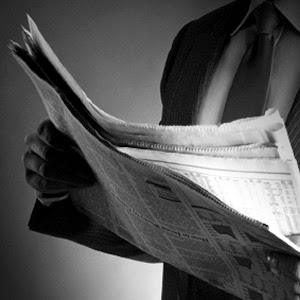 We could speculate as to the reasons why magazines continue to grow as an industry in the face of a declining newspaper industry. But I think the reason is fairly obvious. You see, both medium seek to inform and entertain. But one does that much better than the other. And being the connoisseur of newspapers that I am, I'll suggest that I'm well qualified to weigh in on what's wrong with the newspaper industry. They aren't biased enough.Okay, I did just say that. Newspapers aren't biased enough. Magazines take a position and run with it. Newspapers, on the other hand, spend so much time trying to present a fair and balanced view that they render themselves irrelevant. In fact, they shoot themselves in the foot. A newspaper can take a completely newsworthy story and render it irrelevant with just a headline. Let me explain.Often a newspaper has good news to report. Maybe the unemployment rate dropped, or home sales improved. Perhaps the state met a budget constraint. Or it could be that fewer people died in the war. The point is that often there is good news to report. But the newspapers will douse that good news such that it may be obscured altogether.Let's look at what the newspapers do with good news. The headlines will scream, "Violent Crime Down Across the City." But underneath that will be a tag line that says something like, "But White Collar Crime is Growing." Maybe the headline will read something like, "Better Prenatal Care is Reducing Birth Defects." But the tag line just under that headline will read something like, "But Latest Health Care Legislation Will Reduce Insurance Coverage for Pregnant Women." "New Car Sales Are the Highest in Two Years," will be accompanied by a tag line that says, "But Auto Makers Have Had to Offer Steep Discounts." "Existing Home Sales Doubled in Past Year," will be accompanied by something like, "But Appreciation Rates Remain Soft."Do you see the pattern here? The newspapers will take a solid piece of good news ... and wreck it by coupling it with an opposing piece of potentially bad news. The bad news doesn't even have to be real or factual. It might be something as remote as something not meeting analysts' expectations. If it's even remotely possible it will capture the tag line behind a good news article. Frankly, I think Americans are sick of it. We're bombarded with bad news every day. And we're grown up people. We can take the truth. But we don't find truth in every opposing viewpoint. Frankly, it looks like a spirit of pessimism. It looks like a bunch of crap, to put it bluntly. If new car sales are up, do I care what sales initiative it took to move them? I'm just saying that if Kohl's or Macy's has a big sale, reducing their margins and offering deep discounts, and it incents my wife to buy three times as much stuff ... I still think Kohl's or Macy's are going to be happy about that. I mean they are intelligent retailers and they considered the dynamics of having a sale. They knew that lower margins would increase sales volume --- and they obviously decided it was worth it. But often in business, especially in a politically charged environment where tensions run high, there will be at least one person who likes to "play devil's advocate." No matter what the conversation is about, these wretched individuals always feel compelled to present an opposing viewpoint. Usually they'll offer it with some sort of insincere smile (that looks more like a snide smirk). And they'll deny their suspicious motives. They claim to believe that it's valuable for everyone to hear the negative perspective on the subject. But I am convinced that they are the only ones who feel that this is valuable!People like to think in terms of possibilities --- and not boundaries or limitations. We want to focus on what's possible instead of what's not. We'd rather spend time on good news than on bad news. And when there is good news, we'd like some time to enjoy it before someone rains on our parade with a bad, opposing view.You can call it "fair and balanced reporting." Do that ... and let me know if it sells newspapers. (I am sure that it doesn't.) So you can provide a fair and balanced view, or play devil's advocate all you want. But I promise you, people won't be reading or listening to you if you do. Such is the case with the decline in the newspaper industry today. The world is looking for hope. It's looking for encouragement. And we're looking for it through rose colored glasses. We want to see that glass as half full ... with the promise of rain. Can you just report that fact to us when it is true? Can you leave out the part about how experts see no rain in the immediate forecast and believe that the half-full glass doesn't have enough water to last us through the drought? The next time you pick up a magazine, look at the difference. Most of the magazines in print today will take a topic and dive into it. But they don't dive into the negative possibilities. Magazines stay away from the worry and fret in any story. Instead, they'll build a feature story, presenting the facts. But without the pessimism, the story is inherently better. Even when there's bad news to report, a magazine will take the issue and dissect it in several ways to present it as a story that someone wants to read.I am a confessed connoisseur of the daily news. I read my local Dallas Morning News thoroughly each day. I read several on-line news sources, such as Wall Street Journal, Forbes, Fortune, Associated Press, some foreign newspapers and even the Huffington Post. What I can also count on from the daily newspapers is reporting that is full of good news, obscured by bad connotations. If I want to find encouragement or hope, I have to go to the magazines. Time or Forbes will tell me what's working in the world. The daily newspapers will make sure I know what's not.So you tell me, is "fair and balanced" reporting really worth it? I'm all for freedom of the press. And I would never suggest that the press be forced to do anything that violates that freedom. But if I were a consultant to the newspaper industry, I would sure rebuke them and exhort them to do a better job of printing something that everyone wants to read. It would be a higher calling and a better challenge to package the news in a way that people want to read it (without, of course, compromising its integrity). Or I could just put the integrity of my reporting out there and hope that someone will want to read that. Look at the statistics on circulation from these two industries, and tell me which one is working
.
Old dinosaurs like me who like to read the news, devour and digest it, are probably going to find ourselves with nothing to read. The newspapers will have all gone out of business, because they were so focused on "fair and balanced" reporting that they missed the whole point of journalism.
 Have you ever noticed how information is presented to us in the media? Or maybe you've considered what information is presented to us in the media?
I'm probably one of those old fashioned types - who consumes a newspaper every day, every page and every section. On Sundays I can spend hours with the newspaper. During the week its often a challenge to get through it before I have to get on with my day. Maybe I'd be considered a news junkie or something. Aside from reading my morning paper, I'm also on-line throughout the day, checking out trade media (financial services and religion) and watching the news blogs and other news sites.
What I think is going on here is that I have an inquisitive mind. I've always wanted to know stuff. I've always been curious about life, the world, God, myself, systems, businesses, industries, etc. I'm a voracious reader and always have several books going on my night stand too. But like most people in today's culture, I find that more and more I'm getting my information from sound bytes on TV, radio and Internet. But as convenient as that is, I find myself a little annoyed at least once a day with what is being fed to me in these ways.
Take talk radio for example. I listen to several of the nationally syndicated shows on AM talk radio. But I have to tell you I am sick of the mouthy bigots who just rant and rave - and rant and rave some more about the same old things. They'll waste inordinate amounts of time going on and on about a simple point. Often what they're saying is senseless, useless and even sometimes pretty ignorant. And for those of you who run talk radio shows, when you become senseless, useless or ignorant ... you've lost me as a listener. Watch how fast I can change the dial.
Then there are the news shows on TV. I'm never quite sure how to take them. I think I've blogged before about the role of sports in the news. It seems that they'll dedicate maybe 20% of the air time to sports. So I find myself wondering if sports represents 20% of the importance of the days events globally. (And I doubt very much that it does!) Of course if there's a "weather event" then that can fill an inordinate amount of broadcast time. Our local network stations here in Dallas can talk on and on about a cold front, a lot of rain, etc. I swear we can see the gleam in the meteorologists eyes when there is a "weather event." It's like their adrenaline rushes and they're so excited to have something exciting to talk about. But again, where does it belong in the overall scheme of things globally that day? I really have to wonder.
One of the more popular ... albeit least useful forms of information being fed to us daily is celebrity gossip. There seem to be several "entertainment news" shows out now. And if you watch them, their just gossip. Half of what they report isn't even factual. It's almost as if the nation has become too lazy (or to cheap) to read the National Enquirer and those other trashy tabloids. And sometimes it spills over into the mainstream media. This week, for example, I've been intrigued to see how many people care about what's going to happen with Jay Leno and Conan O'Brien. And yet again, I find myself wondering how much that really matters so much in the face of all the other happenings in the world this week.
So here's the thing. It occurs to me that information for information's sake doesn't really have much value. It seems to be a pretty long walk for information to get to value. Even if there are catastrophic events, why did CNN need to fly Anderson Cooper and Sanjay Gupta to Haiti today to hold microphones under collapsed buildings so we could hear the screams of the people trapped under them? I mean, what is the value of our having that knowledge or that experience?
I know, you'll tell me that it sells and gives them ratings. The news media are simply bringing people what they want. But is that really the news then? Maybe its the ignorance versus the informed. And why does that stuff sell? Why are the ratings higher when there is any kind of drama in the news? Do the consumers of the news not care about the quality of the information they're consuming? Why does anyone want to know how many people are following Oprah on Twitter?
I believe there's a process that things go through. It's systemic too. Things happen --- and that creates data points. But those data points need to grow up and become relevant information. You know, they have to become referenceable, for example. Then the information has to become knowledge. The knowledge needs to become wisdom. Finally, the wisdom must somehow mature into value. And there is the great challenge. It seems to also be where most news reporting falls apart. They take data points and make the assumption that information people of these data points is value. Folks, it really isn't.
Perhaps we would do well to ask the proverbial Christian question, "What would Jesus do? (WWJD?)" Seriously. If Jesus were in charge of ABC News, what do you think He would want the show to be about? What news would He have reported? How would Jesus report the news? Do you suppose things would have been different if Jesus had been a news journalist instead of a carpenter?
I said earlier that I'm a voracious reader and a big consumer of information. The sources and options for getting informed seem to have exploded in my lifetime. Simultaneously, we seem to have slid down a slippery slope far and away from value in this department. While more and more places are spewing news and information from more and more media outlets --- what they're spewing at us is becoming less and less useful or relevant. And while it seems that everyone is focused on what they refer to as "fair and unbiased" news reporting, that is simply them trying to tell us what matters. Meanwhile, it continues to get harder to take the information I consume and convert it to wisdom and value. Why do you think that is? How could we reverse this trend?
 I picked up this morning's paper and was struck with the headline in the business section - screaming out that existing home sales "plunged" 25% from the same period last year. The article went on to report that the inventory of homes to be sold hadn't changed much though, and prices only dropped 1%. If less people want to sell their homes and prices are holding, how bad is this news?
In another headline, a local golf course is shutting down, going out of business. There were pictures and the story went on about how sad everyone was that it was closing. They talked about the wonderful memories there. It was a tear-jerking story. Until you get to the bottom (if you stayed with it that long) and discover the reason the golf course is closing. (Heretofore you were led to believe it was a financial failure.) It turns out the property has been sold to developers for a healthy profit and the owner will be able to retire more than comfortably.
Why isn't the news spun a little better than it is? Let's see a newspaper headlines that say something like, "Despite a 25% decrease in transaction volume, inventory of existing homes for sale and prices are holding steady." Or let's have a headline that celebrates the success of a golf course owner who's been able to cash out. Let's face it, the man has done very well indeed.
What is there about the news that makes the editors want to find the worst angle on any story --- and spin it with that angle? What would the world be like if we all worked to put things in the best (and most realistic) perspective possible?
Don't get me wrong. The world is a nasty place. I know it. You know it. But is it really helpful for us to be so chronically focused on the negatives all the time? At what cost do we overlook the positives? Might we be missing opportunities in life - because all we're looking at are the threats?
I think I should like to start my own newspaper. I'd call it "The Truth & Hope Journal." As the editor in chief, I would be brutally honest about truth. But I'm pretty sure that honest views of things would include some very fine positives. My mission would be to make sure that people aren't ignorant about the world we live in. My mission would be ensure that people see the possibilities and opportunities - while they learn to manage the threats and overcome the weaknesses.
Do you think I could become financially viable in the newspaper business?



 Posts
Posts

